
Pump.fun shipped GO last week. A guy tattooed a misspelled ticker on his forehead and cleared $20K in fees while the token pumped past $600K cap.
The Rundown
- ◆ Pump.fun GO routes bounty payouts straight from memecoin trading fees.
- ◆ A forehead tattoo stunt spawned a Solana token at $600K cap, $3.5M in 24h volume.
- ◆ Nikita Bier and others flagged the platform for weaponizing low-income users for content.
Educational content only. Memecoins carry zero fundamental value by design. Nothing in this article is investment advice.
The Forehead Tattoo That Printed a Solana Token
Pump.fun GO is a bounty board glued to a launchpad. You post a stunt, attach a ticker, someone completes it, and the payout comes from trading fees once the token goes live on Solana.
The loop is brutal in its simplicity. Louder stunt, more volume, fatter fees, bigger payout. Pump.fun clips its cut every time a wallet interacts with the token, so the platform wins whether the bounty is funny, dark, or borderline.
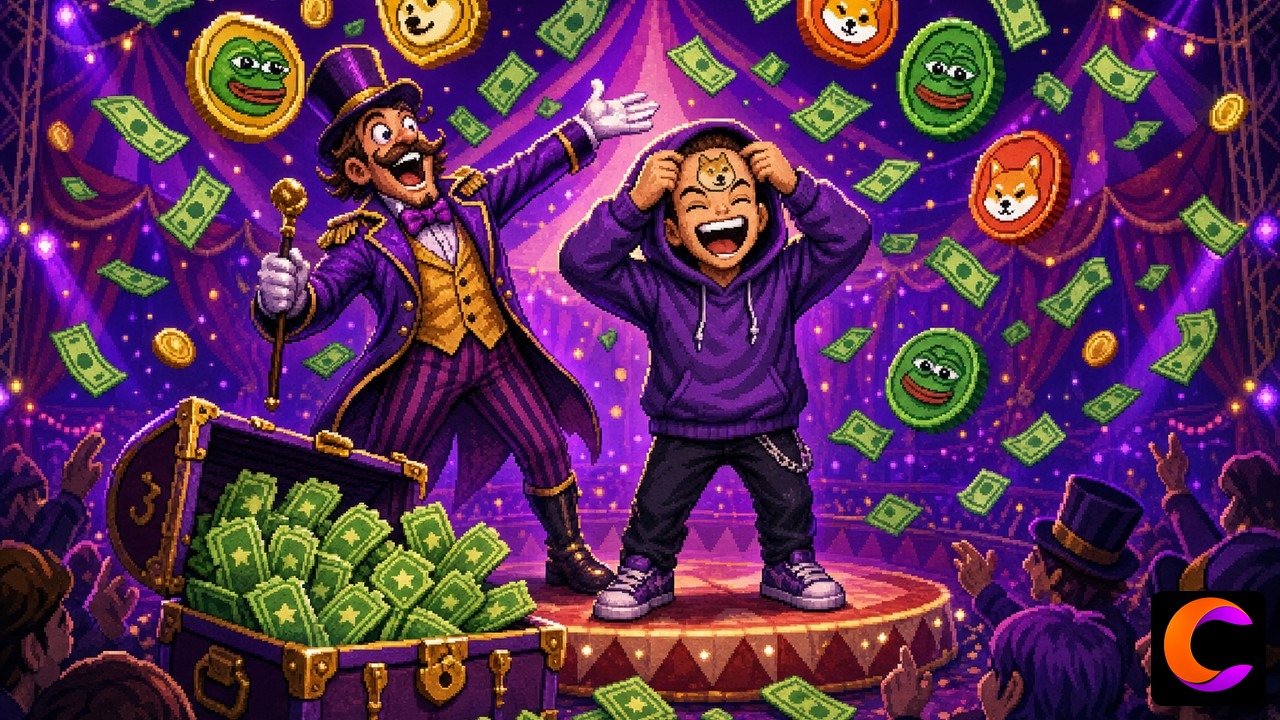
The stunt everyone’s screenshotting came from a user posted as Arivu. He tattooed “$boutywork” on his forehead. Yes, misspelled. The typo turned into the meme.
The token blew up. Market cap north of $600K, roughly $3.5M in 24-hour volume, and Arivu walked away with $20K in trading fees. The creators and early flippers pocketed multiples of that.
That gap between performer and flipper isn’t new. Memecoin platforms have always paid the mercenaries first. GO just industrializes it into a subscription model for viral content.
Bier’s Callout and the Race to the Bottom on Bounties
CoinDesk logged the rest of the early bounties. A watermelon-eating contest paid roughly $93. A user filmed himself walking Skid Row in Los Angeles to interview homeless residents and cleared about $663. Head-shaving challenges cashed close to $266. The memecoin scene has been starving for a fresh narrative after weeks of correction, and GO ate the vacuum.
None of those payouts are life-changing. They’re just large enough to make the offer land in brackets where $200 matters. That’s where the backlash formed.
Nikita Bier posted the meanest read on X. He said the wealthier participants who built crypto culture have quietly left the room, leaving teenagers in America paying poorer people to humiliate themselves on camera for token exposure.
The take lands because the platform can’t really push back on it. GO has moderation, but the incentives reward whatever prints volume. A viral controversy pays more than a wholesome stunt. Do that math for six weeks and you know exactly where the content floor ends up.
For Pump.fun, GO is pure volume engine. Every stunt spawns a token, every token spits fees, every fee funds the next bounty. Daily memecoin issuance on Solana is back at highs after a quiet spring, and the broader market that just got washed out now has a new liquidity pipe to feed on.
The reputational bill lands later. A forehead tattoo is exactly the case regulators screenshot when they want to argue the memecoin economy is exploitative. Either Pump.fun tightens bounty categories and slows the viral flywheel, or it doubles down on the chaos and treats controversy as the marketing line. Memecoin history says chaos wins until it doesn’t, and that reversal usually shows up as a subpoena.
Reminder: memecoins have no intrinsic value. Prices are driven by culture, community, and liquidity depth, not by fundamentals. Any position sizing decision belongs to you. Trade only what you can afford to lose. This article is not investment advice.