

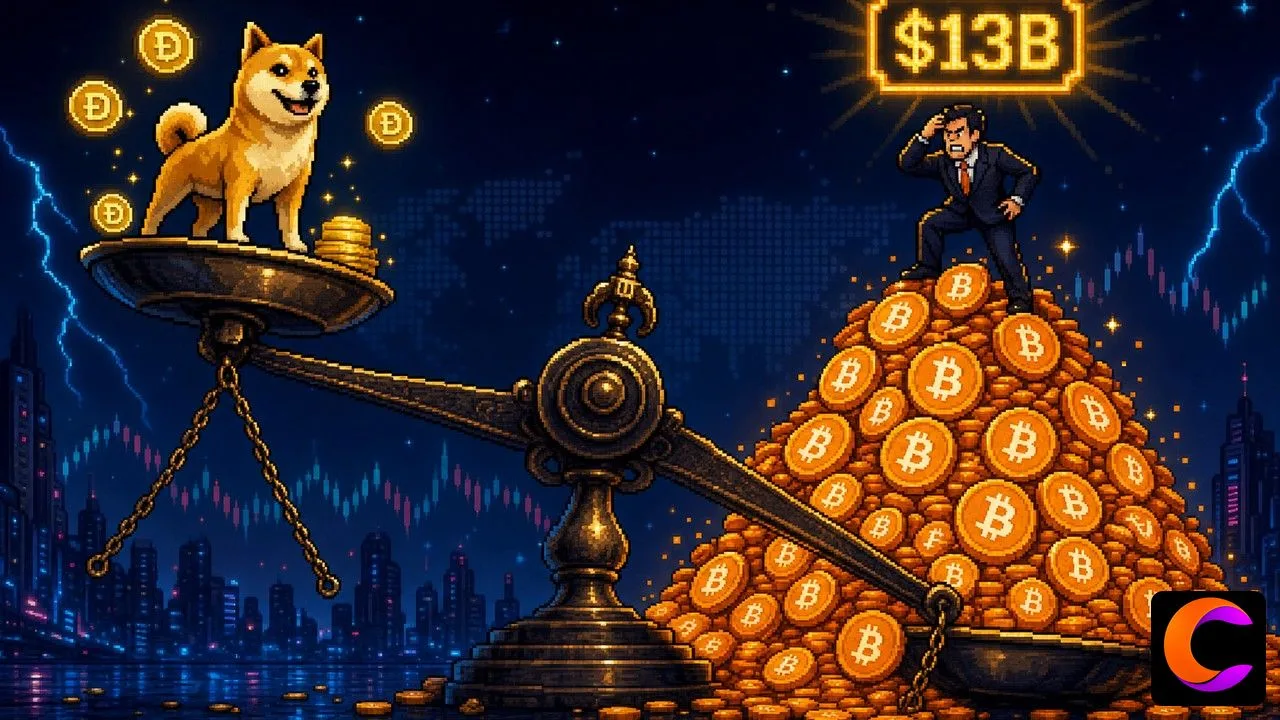
Strategy’s Bitcoin bag is bleeding more paper than the entire DOGE network is worth. One corporate spreadsheet just outweighed a decade of memecoin culture.
The Rundown
- ◆ Strategy holds roughly 844,000 BTC at an average $75,600, now sitting on north of $13B unrealized loss.
- ◆ That single red number is bigger than Dogecoin’s full market cap, floating between $11.5B and $12.7B.
- ◆ Same loss eats past Monero, Cardano, Chainlink, LTC and BCH before it even blinks.
Educational content only. Memecoins carry zero fundamental value by design. Nothing in this article is investment advice.
One Corporate Bitcoin Bag Bigger Than the Whole DOGE Network
Strategy has stacked one of the biggest corporate Bitcoin treasuries on the planet. Latest disclosed position: roughly 844,000 BTC at an average buy price near $75,600.
BTC now hovers near $60,000. Napkin math puts the unrealized paper loss north of $13B on that stack alone. Just paper for now. Still loud.
The number only starts biting when you line it up against the rest of the market. The paper loss now clears the full cap of several so-called blue chips. DOGE is the postcard example. The whole Dogecoin network, ten years old, millions of wallets, sits between $11.5B and $12.7B depending on the hour. Strategy’s red ink is bigger than that.
The list doesn’t stop at DOGE. Monero, Cardano, Chainlink, Bitcoin Cash, Litecoin, BlackRock’s BUIDL, Uniswap, Near Protocol and the newer Aster all individually sit under the $13B mark. Only Hyperliquid, close to $18B, comfortably clears it among recent launches.
The read for memecoin holders is brutal. The narrative that memecoins are too small for institutional flows to matter? Cope. A single quarterly mark-to-market swing on one US software company now moves more value than the entire Dogecoin float.
That rewrites the math on how much memecoin liquidity has to scale before it stays in the room during macro talk. Right now, it isn’t even close.
What This Does to the Memecoin Repricing Thesis
Memecoin culture leans hard on the idea that community size and meme velocity drive long-term value. The Strategy comparison forces an honest look at that thesis. DOGE has roughly 4M non-zero wallets, a national merchandise franchise, recurring mainstream airtime. Its full cap is still smaller than the temporary loss of a Tysons Corner software shop that decided to buy BTC in bulk.
Two reads sit on the table. Bull side: DOGE, SHIB and the rest are wildly underpriced versus their cultural footprint, and one or two clean ETF pipes would close the gap fast. Bear side: memecoins have already tapped a ceiling that speculative crowds can’t push past, because there’s no cash-generating substance underneath to pull balance sheet flows in. The recent DOGE, PEPE and SHIB washout that erased billions in a few sessions just reinforced the bear read.
Both sides have receipts. The first DOGE ETF, REX-Osprey DOJE, got approved in September 2025. Bitwise, Grayscale and 21Shares are still grinding through SEC windows that stretch into early next year. One clean spot product with real institutional distribution and the floor moves up fast. Keep the delays coming and the Strategy comparison stings harder every quarter.
Smaller memecoins are in a rougher seat. BONK, WIF, FLOKI, PEPE and the long tail of Solana launches sit way below DOGE. Zero institutional pipe queued up. The Strategy comparison isn’t even their problem yet, because they don’t register on that scale. The implication holds anyway. One corporate BTC swing can print or erase their full cap in a single afternoon.
The cultural angle isn’t dead. Memecoins remain the cleanest expression of internet culture inside crypto, and that culture is what pulled millions of first-time wallets into the space. Strategy’s paper losses don’t erase that. They just show the scale.
There’s a time-horizon caveat too. Strategy’s loss is paper. BTC clips back to $80,000 and it evaporates overnight, while DOGE could easily drift flat during that leg. Memecoin caps are sticky going down and often ignore short-term BTC noise. This is a snapshot, not a trend.
What actually matters next quarter is institutional access. Three to four pending memecoin ETF decisions, the CLARITY Act circus in DC, the next wave of corporate treasury reveals. Those will decide if memecoins stay a capped cultural sideshow or grow into something no single corporate bag can dwarf.
Right now the chart’s ugly and the comparison hurts. Watching DOGE drift while reading about a $13B corporate Bitcoin wound is a fair reason to ask where the rerating comes from. That answer’s coming from regulators and corporate treasuries, not from the next viral cycle on the timeline.
Reminder: memecoins have no intrinsic value. Prices are driven by culture, community, and liquidity depth, not by fundamentals. Any position sizing decision belongs to you. Trade only what you can afford to lose. This article is not investment advice.