

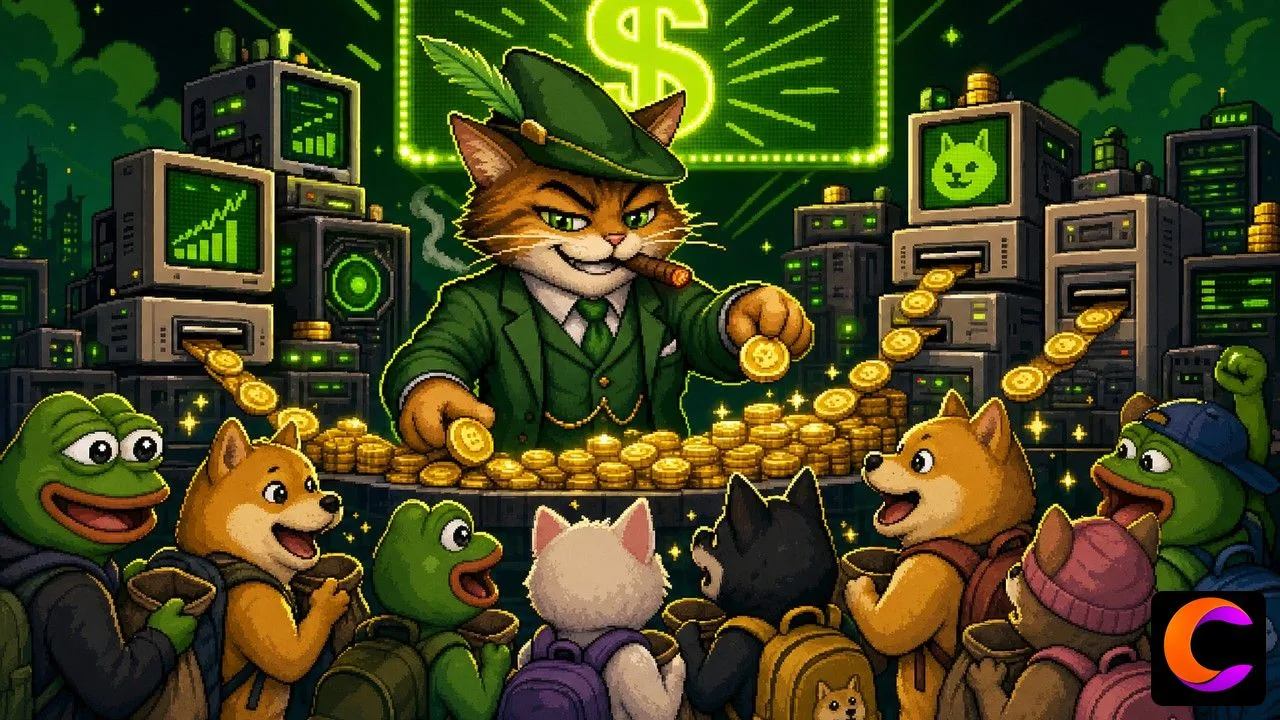
Robinhood Chain memecoins cleared $285M in market cap in a week flat. CASHCAT is eating 57.5% of it alone.
The Rundown
- ◆ Robinhood Chain memecoin segment hit roughly $285M cap in days.
- ◆ CASHCAT alone is $163M, 57.5% of the whole thing.
- ◆ Chain TVL close to $138M, more than 53M transactions logged.
Educational content only. Memecoins carry zero fundamental value by design. Nothing in this article is investment advice.
CASHCAT Just Ate Half the Robinhood Chain Meme Cap in a Week
Robinhood shipped its own L2 in early July, built on Arbitrum tech. Days later, the memecoin segment on it is north of $285M.
CASHCAT ate the room. Roughly $163M, 57.5% of every memecoin trading on the chain. When one ticker takes half a segment in a week, the concentration is doing the storytelling. Everyone else is scrambling for the crumbs.
The chain itself is showing numbers you’d expect from something older. TVL close to $138M. More than 53M transactions logged. Not vanity metrics. That’s what happens when memecoin traders arrive with size and blockspace stays cheap.
The launchpad pattern is familiar. Every wave of memecoin liquidity since 2025 landed on a specific stack (Solana for the Pump.fun era, Base for the Zora meta, now Robinhood Chain). Traders rotate. The venue moves. The plot doesn’t.
There’s a Pump.fun echo here that’s hard to ignore. Pump.fun crossed $1B in cumulative revenue before Robinhood Chain even shipped. The PUMP token just unlocked $118M of fresh supply on July 12. Retail liquidity for memecoins isn’t shrinking. It’s redistributing across chains, faster than most watchers assumed.
Robinhood’s user base is the tell. Not a Solana meta rerun. The crowd touching Robinhood Chain memecoins is different, half retail traders already inside the app, half memecoin natives sniffing early plays. That mix makes takeoffs faster and probably shallower.
Airdrop Farmers, Cheap Gas, And a Retail Brand That Actually Prints
The immediate driver is the airdrop hunt. Every new L2 launched in the last eighteen months has produced a wave of on-chain activity fueled by airdrop farming. Robinhood Chain fits the template exactly. Bridge in, spin up a wallet, mint a couple of memecoins, start clicking. Some of that activity is real trading. A big chunk is airdrop optimization dressed up as engagement.
The narrative angle is even stronger. Robinhood is a listed US company with a retail brand that outlives crypto cycles. The chain isn’t a random Discord experiment. That mainstream layer over crypto memecoins is a new frame for a lot of traders. Even skeptics owned it: the concept alone is pulling attention that other L2s spend six months trying to earn.
The CASHCAT concentration is a signal you can’t wave off. When one memecoin takes 57.5% of segment cap, it means either an insanely strong community formed almost overnight, or a small handful of wallets absorbed the early float and dominate the depth. Both have happened before on other chains. Both point to a violently asymmetric setup for anyone showing up now.
The market cap flow is the next signal. If the $285M number plateaus and starts rotating within Robinhood Chain (money leaves CASHCAT for smaller tickers), the takeoff is real and memecoin culture has adopted the chain. If it drops fast back below $150M and CASHCAT stops leading, the L2 becomes another failed airdrop farm. The read is binary. The answer comes in weeks, not quarters.
One rule holds across every memecoin cycle since 2013. First movers on a new chain print outsized returns for a very short window. The window then closes brutally. Anyone arriving to Robinhood Chain memecoins after this weekend is already the second mover, and second mover in memecoin land is a rough seat.
Reminder: memecoins have no intrinsic value. Prices are driven by culture, community, and liquidity depth, not by fundamentals. Any position sizing decision belongs to you. Trade only what you can afford to lose. This article is not investment advice.